

This week in the sky…
By George Chudley, StarTalk Writer
Black holes are voracious, insatiable, all-consuming. So what happens when one gets a bad case of indigestion?
If you know anything about black holes, you probably know that nothing, not even light, can escape from them. (Well, except for Hawking radiation, but that would take an entire article of its own to explain!) Indeed, the “event horizon” of a black hole marks the point of no return for anything being sucked in. Black holes are very, very hungry—but they’re also very, very messy eaters.
As a team of astronomers using the Very Large Telescope (yes, that’s actually what it’s called) found out, it appears that significant portions of a black hole’s meal may never reach the event horizon at all. Instead, it’s ejected back into the universe by powerful “black hole winds.”
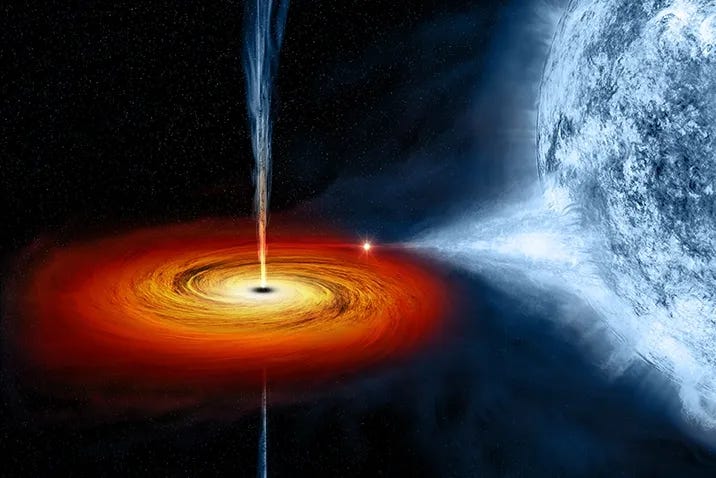
The specific black hole system being studied, Swift J1727.8−1613, gets most of its food from a nearby companion star, stripping away stellar material from the star’s outer surface. This materials forms a rotating “accretion disk” which the black hole can grab its meals from, like the universe’s largest revolving sushi bar.
This accretion disk structure is actually not dissimilar from how planets form around young stars. The main difference is that accretion disks rotate much faster than so-called “protoplanetary disks” and are superheated by their black hole’s gravitational influence.
Back in 2023, Swift J1727.8-1613 released a massive burst of X-rays, catching the attention of the Very Large Telescope team. They found that this burst was caused by the black hole violently ejecting massive amounts of material, far more than had been seen in similar systems previously—and that revelation changes a lot about how we view black holes in general.
We tend to think of black holes as bottomless pits that suck in everything around them, but as it turns out, they’re a lot less efficient than we think. In fact, the scientists believe that the amount of matter carried away by black hole winds might eventually add up to the same amount the black hole actually consumed, literally throwing away half of its meal!
Through close observation this feeding frenzy, astronomers have uncovered a new picture of how binary star systems develop. That said, they did get that picture by watching a black hole get sick to its stomach.
Disgusting? Maybe. Scientifically fascinating? Definitely. Looks like sometimes, even a black hole bites off more than it can chew!
Did you see this?
Catch up on the latest video drops from StarTalk:
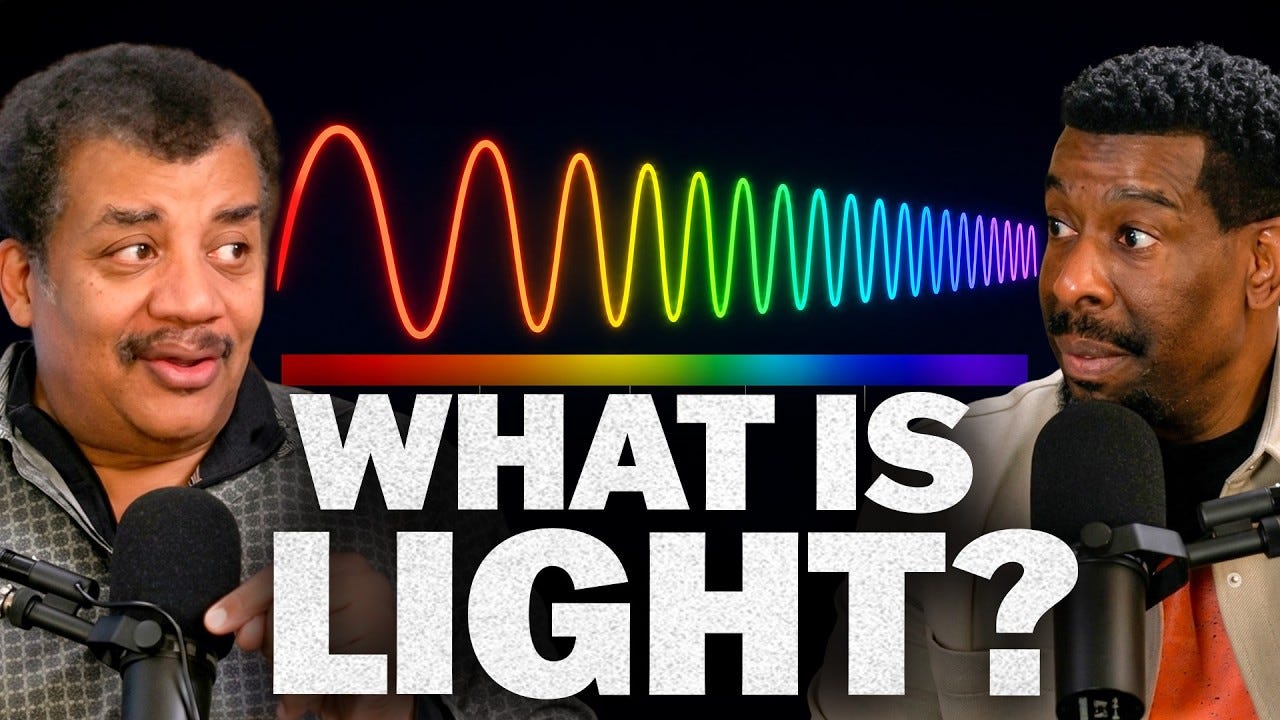
What is light?
Neil deGrasse Tyson and Chuck Nice break down perhaps the most important explainer. Learn how electricity and magnetism joined forces (or fields) to become the electromagnetic spectrum we know today.
Coming Up on StarTalk...
Full Episode: Cosmic Queries Grab Bag
Special Edition: Stars Ask
Listen on your favorite podcast platform or watch on our YouTube channel.
Have you checked out our all-new SECOND channel yet?

The newest addition to the StarTalk Multiverse is where we post podcast highlights and fun original content that doesn't quite fit on the main channel.
StarTalk Books
This enlightening illustrated narrative by the world’s most celebrated astrophysicist explains the universe from the solar system to the farthest reaches of space with authority and humor.